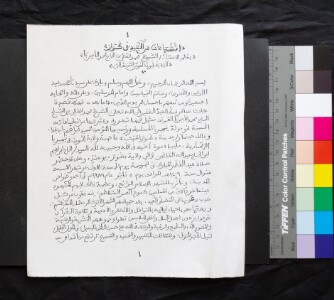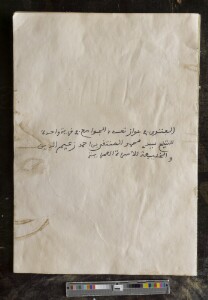

This manuscript is a commentary on a book originally written by Imam Abu Hassan Aliyi Ibn Khasim a-Zakkaasī. It was copied by Muhammad bun Abd al-Salaam, then by Umar Tāl. In the manuscript, Al-Salaam does not provide the dates or the place where he wrote the manuscript. According to the custodian, the local copying was probably completed sometime in the 19th century. The manuscript is divided into 8 parts. The first deals with the issues of judgments among Muslims, the manner in which the judge must begin the trial, the manner in which the parties involved - accused and defending - must present their arguments and what they must do. The second part deals with the different types of judgments that exist. The third details the requirements of a trial, for example, witnesses and their roles. Part 4 explains the circumstances in which a person may find a representative for a trial that they can not attend. Part 5 explains how a judge should approach trial procedures for similar cases. Part 6 addresses issues of morality and the best values that a Muslim must adopt. Part 7 provides information on famous trials that took place. Part 8 explains how to provide and evaluate evidence for a particular judgment.
Ce manuscrit est un commentaire d'un livre écrit à l'origine par l'imam Abu Hassan Aliyi Ibn Khasim a-Zakkaasī. Il a été copié par Muhammad bun Abd al-Salaam, puis par un autre savant peul de la famille Tall dont le nom est inconnu. Dans le manuscrit, Al-Salaam ne fournit pas les dates ni le lieu où il a écrit le manuscrit. Selon le gardien, la copie a été achevée au 19e siècle. Le manuscrit est divisé en 8 parties. La première traite des questions de jugements parmi les musulmans, de la manière dont le juge doit entamer le procès, de la manière dont les parties impliquées - accusées et défendantes - doivent présenter leurs arguments et ce qu'elles doivent faire. La deuxième partie traite des différents types de jugements qui existent. Le troisième détaille les exigences d'un procès, par exemple les témoins et leurs rôles. La partie 4 explique les circonstances dans lesquelles une personne peut trouver un représentant pour un procès auquel elle ne peut assister. La partie 5 explique comment un juge devrait aborder les procédures de jugement pour des affaires similaires. La partie 6 aborde les questions de moralité et les meilleures valeurs qu'un musulman doit adopter. La partie 7 fournit des informations sur les procès célèbres qui ont eu lieu. La partie 8 explique comment fournir et évaluer les preuves d'un jugement particulier.
Extent: 1 manuscript contaning 266 pages.
Size and dimensions of original material: Height 20cm, width 14cm, depth 2mm.
Condition of original material: unbound file in leather cover, pages are legible, black and red ink, foxing on paper, pages slightly torn on edges, not affecting content.
Custodial history: According to the current guardian, the manuscript waås owned by Ceerno Seydu Nourou Taal (1862 - 1980). Upon his death, he passed them down to Muntaga Taal, who in turn passed then down to the current Calif of the Taal family in Dakar, Madani Taal.
Author(s)/Creator(s): Imam Abu Hassan Aliyi Ibn Khasim a-Zakkāsī.
Scribe(s): Unknown.
Related countries: Saudi Arabia, Senegal.
Related regions: Islam.
Related towns/cities: Makkah; Madina; Cairo.