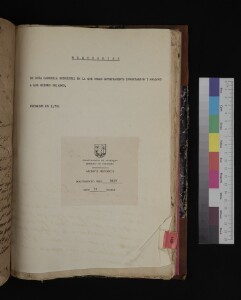

estate settlement proceedings of Isabel Rodríguez de Vivanco Contains a closed will in which she declares that she owns a tiled house with a plot of land, lands and salt springs in the site of Abejuco, an estancia with a plantain field, cane field and a mill, and a team of 38 enslaved individuals in the site of Los Osos, including several people of Arará and Congo origin, children and a bricklayer named Marcos (creole) The latter worked on the construction of the church of Jesus of Nazareth and, according to a clause in the will, was not to be sold, a disposition that was later declared invalid because it contravened royal laws The deceased also acknowledged that holding an enslaved male named Juan de León (the surname Masato is also mentioned), who belonged to Miguel Vivas Sedano, a householder of Buga, governor of Popayán, and who was pledged to Captain Esteban Jaramillo de Andrade, the deceased's husband, for 160 Pesos in gold José de Villa y Posada claims the enslaved individual in the name of his uncle, Vivas Sedano Records the death of an enslaved male named Antonio who worked on the herd Includes a codicil, inventories and appraisal of assets, and receipts for the payment of debts and funeral expenses.
Mortuoria de Isabel Rodríguez de Vivanco. Contiene testamento cerrado en el que declaró poseer una casa de tejas con su solar, tierras y salinas en el sitio de Abejuco, una estancia con platanar, cañaduzal y trapiche, y una cuadrilla en el sitio de Los Osos integrada por 38 esclavizados, entre los que se encontraban varias personas de origen Arará y Congo, niños y un oficial de albañil llamado Marcos (criollo). Este trabajaba en la construcción de la iglesia de Jesús de Nazareno, según cláusula del testamento este no debía ser vendido; disposición que después fue considerada inválida por contravenir las leyes reales. La difunta también reconoció tener en su poder a un esclavizado llamado Juan de León (también se menciona el apellido Masato), que pertenecía a Miguel Vivas Sedano, vecino de Buga, gobernación de Popayán, que fue empeñado por 160 pesos de oro al capitán Esteban Jaramillo de Andrade, esposo de la difunta. José de Villa y Posada reclama al esclavizado en nombre de Vivas Sedano, su tío. Registra la muerte de un esclavizado llamado Antonio que trabajaba en el hato. Incluye un codicilo, inventarios y avalúos de bienes, y recibos de pago de deudas y de las costas del funeral.
Extent: 193 paper folios.
Condition of original material: Very badly deteriorated. Much of the document shows signs of oxidation of the paper and is affected by iron gall ink, especially folios 12-17, 48-53, 57-71, 84-87, 101-109, 119-120, 143, 147, 149, 152-161, 169-170, 172-178, 181-188. Some folios have tears and stains. Folios 56-60, 102, 160 have tears in the lower margin. Folio 82 is creased and torn at the inner margin. The ink on folio 93 is blurred, which may make it difficult to read. Folios 176-177 are poorly bound. Folio 190 is severely damaged, in addition to being affected by iron gall ink, and is torn at the bottom; folio 193 is torn at the top.
Scribe(s): Alonso García Galvis; Luis Bernardo Sarrazola: Martín Hidalgo.
Original institution reference: Co.AHA/Mortuorias_T291_D5853/f1r-193v.
Related places: Colombia, Medellín, Santa Fe de Antioquia, Itagüí, Buga, Cali, Popayán