
Aims and objectives
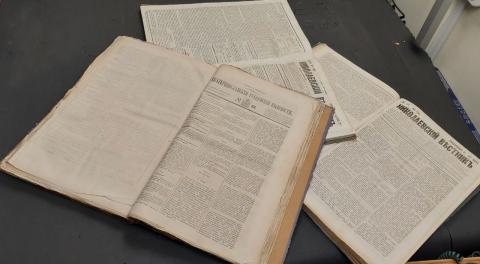
Ukrainian scientific, educational and socio-cultural institutions in the 19th and 20th centuries played an important role in the formation of science, education, literature, art, women's rights and economics in the country. The project intends to digitise documents concerning the activities of these institutions (such as statutes, activity reports, protocols of meetings, congresses, documents on branch and international activities) as well as rare printed periodicals and museum collections. Digitising the collections makes accessible the tradition of scientific, socio-cultural, economic, and educational connections of Ukraine, which have existed for centuries with the institutions of central and eastern Europe.
Outcomes
Within the framework of the project, 13 digital collections have been created, totaling 58,646 digitized files. Each collection includes prepared digital copies of documents relating to the organizational and scientific activities of Ukrainian institutions that operated on Ukrainian lands in the 19th - first half of the 20th centuries stored in the Central State Historical Archive in Lviv and the library of the Shevchenko Scientific Society.
The documents were created during the period when Ukrainian lands were part of the Austro-Hungarian Empire (until 1918), Russian Empire (until 1917), Republic of Poland (1919-1939), Kingdom of Romania (Northern Bukovina 1918-1940) Czechoslovak Republic (Transcarpathia 1919-1939), Ukrainian Soviet Socialist Republic (Western Ukraine from 1939, Northern Bukovina from 1940, Transcarpathian Ukraine from 1945), Third Reich (1941-1945). The extreme chronological dates of the documents refer to November, 22, 1845 - November 10, 1944. Most of the documents date back to the time between the two world wars of the 20th century, territorially originating from the Ukrainian lands, which at that time were part of the Republic of Poland.
The collections of digital copies are named after the institutions. Among them the most important are: the Shevchenko Scientific Society, Prosvita, Ridna Shola, Ukrainian Secret University, Petro Mohyla Ukrainian Scientific Lecture Society, Andrey Sheptyckiy Lviv National Museum, cultural and educational society Halyts'ko - rus'ka matytsia, Society Ruska Besida, Rus' (Ukrainian) Folk Theater, Vatra, Society Union of Ukrainian Women.
Two collections are named after their storage location: The first is the Library collection of the Central State Historical Archive in Lviv (it includes collections of digital copies of incomplete sets of rare printed periodicals, journals, newspapers and series of the Prosvita Society (Zhyttia i nannia), Ukrainian Pedagogical Society Ridna Shkola, Rus' Pedagogical Society (The Teacher, Ridna Shkola), National Museum in Lviv (Chronicles of the Andrey Sheptyckiy Lviv National Museum) Halyts'ko-rus'ka matytsia (Scientific collection), women's society Union of Ukrainian Women (newspaper Zhinka). The second is the collection of the Library of the Shevchenko Scientific Society in Lviv (Vynnychenko St., 24) preserves the journals of individual sections and serial publications of the society. Each publication has an archive library number.