
Archive type
Content type
Showing 1 to 15 of 22 results
-
Rupiah Coin [1945]
2.5 cent dated 1945. Letters in Jawi and Javanese script are printed on one side of the coin, and the Dutch East Indies logo on the other side. 2…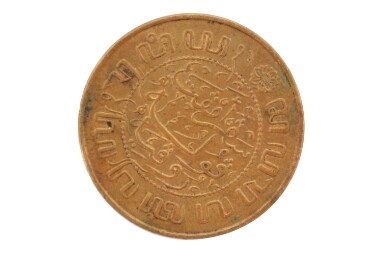
-
Rupiah Coin [1858]
2.5 cents Dutch East Indies coin dated 1858. Letters in Jawi and Javanese script are printed on one side of the coin, and the Dutch East Indies…
-
Rupiah Coin [1857]
2.5 cents Dutch East Indies coin dated 1857. Letters in Jawi and Javanese script are printed on one side of the coin, and the Dutch East Indies…
-
Coin [after 1500]
Coin of unknown provenance due to heavy patination all over the surface.
-
Healing Stones (Mentiko)
These stones are believed be able to cure diseases and to neutralise poison. In most applications the stones are immersed in water, and the water…
-
Anti-Poison Stones (Mentiko)
These sacred stones are believed be able to cure diseases and to neutralise poison. In most applications the stones are immersed in water, and the…
-
Healing Stones (Mentiko)
5 healing stones of which the largest is called Salih Bujang Dayang Keramat, the black one Salih Kuning Terawang Lidah and the yellow one Salih…
-
Bowl [after 1850]
Bowl for serving food. Made by Petrus in the Netherlands.
-
Bowl [after 1863]
Bowl for serving food, partialy broken. Pottery mark "Société Céramique Maestricht. Made in Holland".
-
Bowl [Klasik]
Bowl for serving food with faded blue design. Most likely of Chinese provenance.
-
Glass bowl
Vessel for storing oil used in healing rituals.
-
Kris
Ceremonial dagger used as part of the customary attire. Keris of unknown provenance, but most likely a Malay or Minangkabau product. Upper part of…
-
Small Kris
Ceremonial dagger used as part of the customary attire. Arabic inscriptions: La haulawalakua ta illa billah, and Inna natahaa laka fatah.…
-
Coconut shell
Vessel for ritual items. These coconut shells, locally known as cimani or cibuk, are used at rituals and filled with sacred stones (mentiko) or…